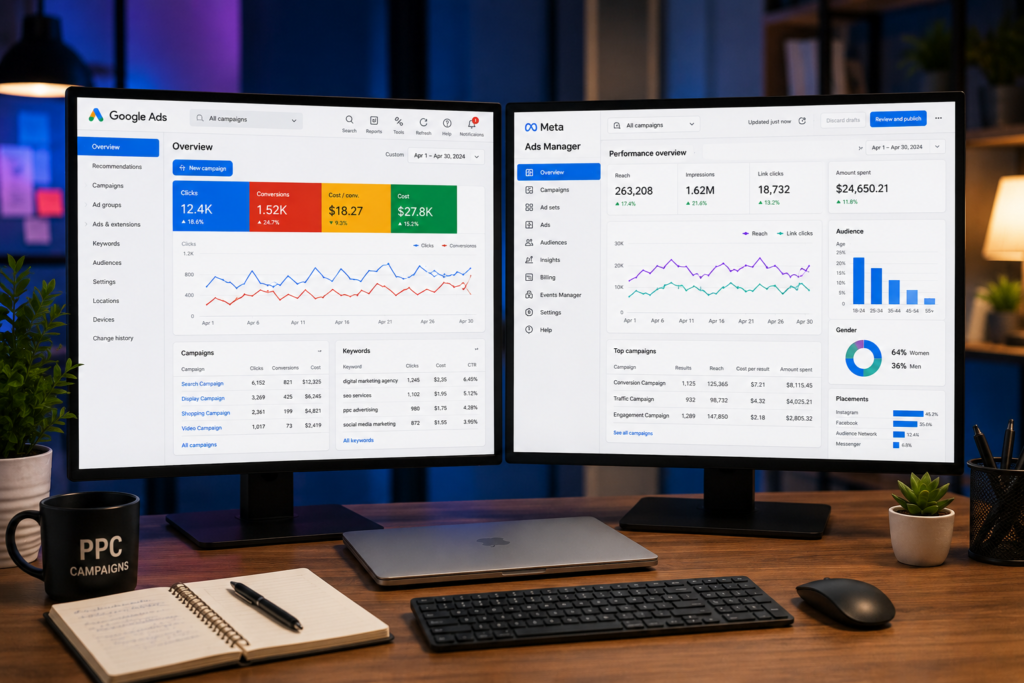
Google Ads vs Meta Ads: Which One Should Your Business Choose in 2026?
Google Ads vs Meta Ads—which one is the right choice for your business in 2026? It’s a question many business owners ask when they’re ready to invest in online advertising. While both platforms can deliver great results, they work in different ways. Understanding their strengths can help you choose the right strategy and make the most of your marketing budget.
What are Google Ads?
Google Ads : is the online advertising platform used by Google to run advertisements on Google Search, YouTube, Google Maps, Gmail, and its network of partner websites. Google Ads’ greatest asset is that it targets users who are actively searching for a product or service.
Let’s say you own a local bakery. If someone searches Google for “best birthday cake near me,” your advertisement can appear right at the top of the results. Because the customer already knows what they’re looking for and intends to buy, they are much more likely to click your ad and make a purchase.
Google Ads operates on a Pay-Per-Click (PPC) model, meaning you only pay when someone clicks on your ad. This makes it ideal for businesses focused on driving leads, phone calls, website visits, and direct sales.
What are Meta Ads?
Meta Ads : refer to advertisements seen on Facebook, Instagram, Messenger, and the Meta Audience Network. Unlike Google Ads, which relies on what people search for, Meta utilizes data such as their interests, age, location, online behaviour, and past interactions to display relevant ads.
For instance, as someone scrolls through their Instagram feed, they might encounter an ad for a new clothing line or a fitness app because they’ve demonstrated interest in similar content in the past. They weren’t necessarily looking for it, but the ad caught their eye.
This makes Meta Ads excellent for increasing brand awareness, promoting visually appealing products, and building an engaged online community.
Google Ads vs. Meta Ads: Key Differences
The most significant difference between the two platforms lies in customer intent.
With Google Ads, individuals are already actively searching for a solution. They know what they need and are looking for a provider. That’s why Google Ads often delivers quicker conversions and higher-quality leads.
Meta Ads function differently by focusing on discovery. Your ad appears while people are passively browsing social media, providing an opportunity to introduce your brand before they are actively in the market to purchase. Although conversions might take a bit longer, Meta Ads are fantastic for building trust and keeping your brand top of mind.
Another crucial distinction is the type of content that performs well. Google Ads heavily relies on keywords and compelling ad copy, while Meta Ads require striking visuals, videos, Reels, and engaging narratives to grab attention.
Which Platform Should Your Business Use?
If your primary goal is to generate enquiries, bookings, or sales rapidly, Google Ads is generally the superior choice. It works particularly well for businesses like digital marketing agencies, hospitals, educational institutions, real estate firms, and local service providers, as customers are already searching for their offerings.
Conversely, if you’re introducing a new brand, promoting a product, or building a robust presence on social media, Meta Ads can yield impressive results. Companies in fashion, beauty, fitness, food, travel, and e-commerce often see great engagement on Facebook and Instagram.
Why Many Businesses Use Both Platforms
Deciding between Google Ads and Meta Ads doesn’t always have to be an either/or scenario. Many successful businesses utilize both platforms simultaneously.
Consider your own online behaviour. You might discover a brand while browsing Instagram and then search for that brand on Google a few days later when you’re ready to buy. A business running both Meta Ads and Google Ads has two opportunities to connect with you before you make a purchase.
This combined approach creates a more seamless customer journey and often leads to better overall results compared to relying on a single platform.
Final Thoughts
When evaluating Google Ads vs. Meta Ads, the best decision depends on your specific business goals, not just on which platform is more popular. Google Ads excels at reaching customers with immediate purchase intent, while Meta Ads is ideal for building awareness, engaging audiences, and maintaining top-of-mind status.
If your budget permits, integrating both platforms can create a balanced digital marketing strategy that not only attracts new customers but also strengthens long-term relationships. Before investing, carefully consider your audience, define your objectives, and choose the platform that aligns with your goals. A well-planned campaign will always outperform a large budget without a clear strategy.
The best marketing strategy depends on your business goals. At Rosxforge, we help businesses make the most of Google Ads, Meta Ads, and email marketing with campaigns that are built to deliver real results.